Be yourself; Everyone else is already taken.
— Oscar Wilde.
This is the first post on my new blog. I’m just getting this new blog going, so stay tuned for more. Subscribe below to get notified when I post new updates.
Be yourself; Everyone else is already taken.
— Oscar Wilde.
This is the first post on my new blog. I’m just getting this new blog going, so stay tuned for more. Subscribe below to get notified when I post new updates.
Science Vs: Coronavirus Outbreak: How Scared Should You Be?
The podcast science vs from Gimlet explores the recent outbreak of the coronavirus: the outbreak, how it’s spread, and what other countries are experiencing. As of January 30th, 10000 people have been confirmed to have the coronavirus with about 200 people dead from it. The virus has been confirmed to be found in almost every continent, with the world health organization declaring an international public health emergency. The virus is theorized to be coming from bats, with some intermediate host carrying it to humans. This host could be any animal, but it is likely that it would be an animal that has been traded for food or whose excrement lies around in a place where many Chinese live. As for when the actual virus started, it is unlikely that, as some theorize, it has been around for a long time but covered up by the Chinese government, as there simply haven’t been enough mutations in the virus for it to have been around that long- it was simply spread very quickly. It is spread not as an airborne disease, but mainly through human fluids such as saliva and sneezing. This is hypothesized because the average amount of people infected due to one person for coronavirus is about 1.5 to 3, much less than the 15 people which is usual for airborne diseases such as measles. The fact that the coronavirus has only been around for about 3 months and has infected and killed so many people is terrifying, and no one knows quite how to combat its effects yet. The fact that it comes from bats is very intriguing to me, as I wonder which viruses and outbreaks have been spread by bats in history and whether that information could give us an idea of what the intermediate host could be for this virus. It is also reassuring that the virus has not been covered up from the public eye for a much longer time than expected.
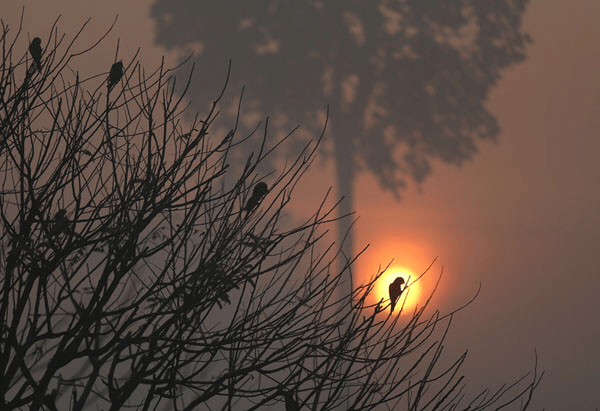
The photographer is condemning the environmental damage that people have created on this planet which is shown perfectly by the fact that the Amazon rainforest, a biome almost four times the size of Alaska and one of the biggest rainforests in the word, is burning. The fire occurred mostly due to the rise in agricultural farming in deforested areas which lead to fires burning first in these deforested areas then spreading to the rest of the forest. However, despite the clear condemnation of the picture, it is also one of hope. The sun is rising on a new day, and in spite of the fires burning around them, the birds are still surviving in their damaged home. Moraes is clearly looking towards a brighter future where humans might show responsibility for their actions and aid in the reconstruction of the Amazon after the destructive fire. In my opinion, the photo is a prime example of the damage that climate change and humans refusal to work together to improve the environment is causing. The Amazon rainforest, one of the most important places in the world in terms of keeping our earth’s environment healthy, is burning due to the actions of humans. From what I have seen though, the idea of hope goes beyond just birds. Over the course of the decade, the Brazil government has put in place several laws which will slow down the deforestation of the Amazon, including bolstering law enforcement, protecting lands, and punishing counties which did not reduce deforestation.
What’s the weirdest place in the world and why?
One of the weirdest places in the world which I found is a tiny island off the coast of Japan, okunoshima. It is inhabited almost entirely by rabbits, and has become a popular tourist attraction because of it. The legend behind this surplus of rabbits is even more intriguing. During World War II, when chemical weapons were being created by both sides of the war, the Japanese had used the island to test the chemicals on the rabbits. A common theory is that the rabbits on the island are the descendants of those chemically changed rabbits. Experts, however, see this theory as nothing more than a myth. American soldiers had euthanized every rabbit who had been tested soon after the war reached an end, and it is more likely the rabbits come from a careless tourist who set one free and now, decades later, the island has hundreds roaming the streets. Another interesting place I found was the Nazca Lines of Peru. These lines are long, geometric figures and animal figures which go up to 200 meters. It is one of South America’s unexplained mysteries. The lines are on salt flats, and from the aerial view the shapes they form are so perfect that a common theory is that they could only be of alien origin. Even more intriguing is the fact that they are all drawn in a single line, which seems to be beyond the technology of the time. Finally, the last interesting place I found was the Red Beach in Panjin, China. This beach is converted into a special kind of seaweed which turns bright red in autumn. It is an important part of its environment as a type of migrating bird which settles there uses the red seaweed as a place for their nest. The seaweed is called sueda, and it is unique to its area in China and is found almost nowhere else in the world.
This is an example post, originally published as part of Blogging University. Enroll in one of our ten programs, and start your blog right.
You’re going to publish a post today. Don’t worry about how your blog looks. Don’t worry if you haven’t given it a name yet, or you’re feeling overwhelmed. Just click the “New Post” button, and tell us why you’re here.
Why do this?
The post can be short or long, a personal intro to your life or a bloggy mission statement, a manifesto for the future or a simple outline of your the types of things you hope to publish.
To help you get started, here are a few questions:
You’re not locked into any of this; one of the wonderful things about blogs is how they constantly evolve as we learn, grow, and interact with one another — but it’s good to know where and why you started, and articulating your goals may just give you a few other post ideas.
Can’t think how to get started? Just write the first thing that pops into your head. Anne Lamott, author of a book on writing we love, says that you need to give yourself permission to write a “crappy first draft”. Anne makes a great point — just start writing, and worry about editing it later.
When you’re ready to publish, give your post three to five tags that describe your blog’s focus — writing, photography, fiction, parenting, food, cars, movies, sports, whatever. These tags will help others who care about your topics find you in the Reader. Make sure one of the tags is “zerotohero,” so other new bloggers can find you, too.

 Afreen’s Blog